How Vantagepoint Handles On-Call Contracts
Fri Oct 16 2026
Master agreements, IDIQs, and pre-quals don't fit Vantagepoint's one-pursuit-one-project model. Here's how we modeled them without adding a second system for users to learn.
Written by: Wesley Witsken
I hear this question constantly: how does Vantagepoint handle On-Call Contracts?
The name changes depending on who’s asking. Master Agreements, IDIQs, Pre-Quals, a spot on a shortlist. The concept is the same. You pursue a solicitation, you win a place on a list, and the actual projects come later through competitive pursuits under that agreement. The pursuit doesn’t lead to a contract. It unlocks OTHER pursuits for contracts.
Master agreements also have features of their own. They carry their own clients and their own proposal process, and they often come with a do-not-exceed limit that every project under them counts against.
Where Vantagepoint falls short
Vantagepoint assumes one pursuit leads to one project. A master agreement is one-to-many by nature, with a financial ceiling on top. The platform can’t show how an umbrella pursuit connects to everything underneath it, so firms end up tracking contract value, revenue, and remaining capacity through spreadsheets and workarounds. I’ve seen it come up with client after client, which is how I know it’s a gap in the platform and not one firm’s quirk.
The first approach, and why we went a different way
Deltek’s own solution centered on a separate Master Agreements hub where you enter the information. It works, but it pulls the agreement out of the pursuit. The master agreement isn’t tracked as an opportunity in the pipeline anymore, and users have to learn a second place to work.
We wanted the opposite. The master agreement should stay inside the way firms already work.
What we built
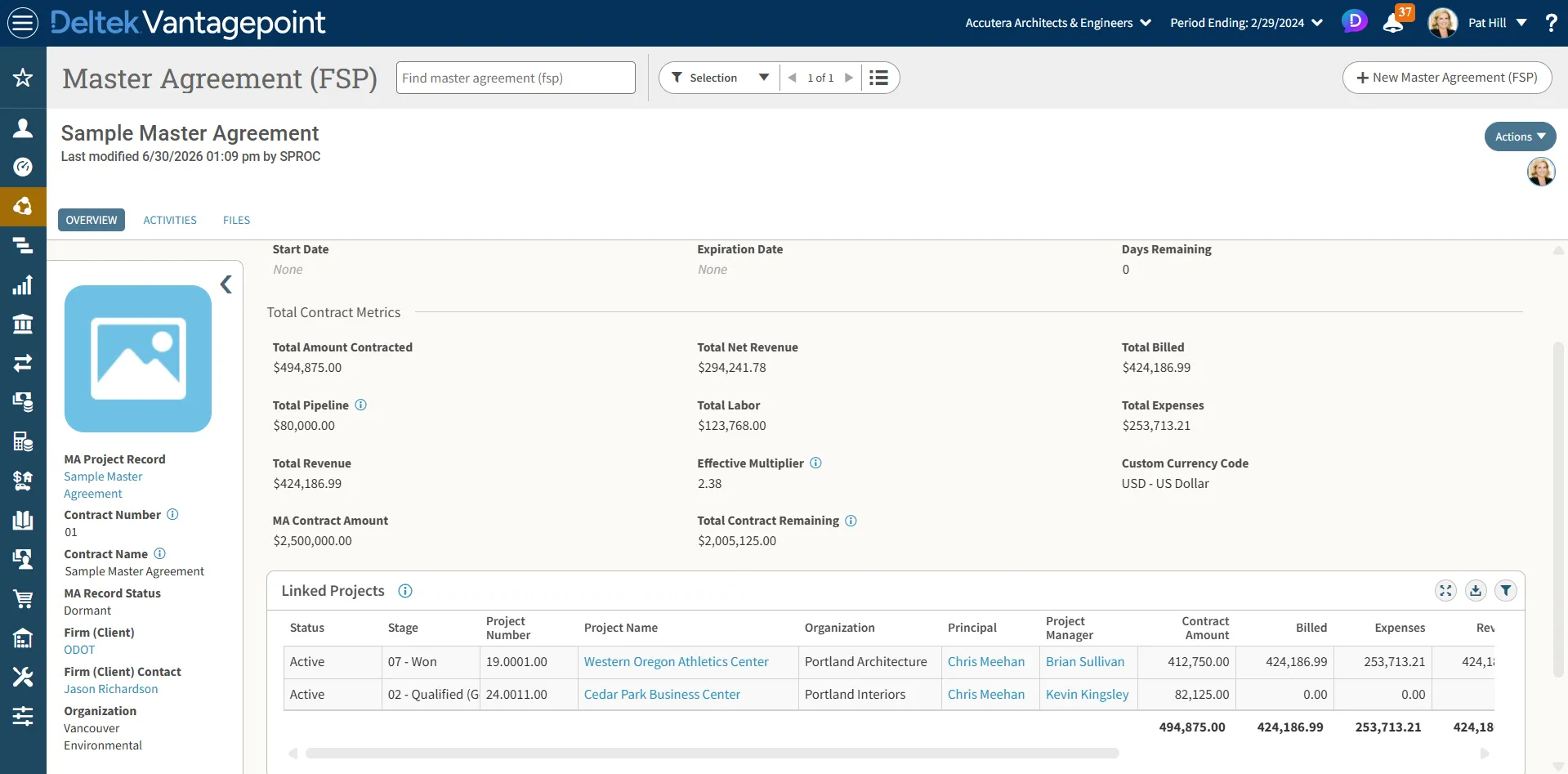
In our version, the master agreement remains a project record, so it lives in the pipeline like any other pursuit. Users go through the ordinary steps of the pursuit lifecycle. A custom hub links to that record and to every child project underneath it, and it mostly displays what flows in from the project data. It isn’t a place to key things in. Nobody has to learn a second system, and the whole agreement is visible in one place.
Three of us built it: a senior consultant, a SQL developer, and me. The other consultant and I co-authored the design. I took the lead on where the financial data should come from and drafted how it needed to flow, and I reviewed the code. The SQL developer implemented it and worked through changes with us as we refined the requirements.
How it’s gone
It came together quickly and has become a repeatable offering. We’ve sold it 10+ times. The best reaction came right after I showed it on a demo call: “How soon can we get it implemented?”
What I took from it
Good customizations come from knowing the domain. We started with a limitation in the tool, compared it against what clients kept needing, and made choices based on what we’d seen work in real firms. The one that mattered most was the simplest: keep people in the tool the way they already use it.
If you’re tracking on-call contracts in Vantagepoint and it feels like you’re fighting the system, I’m happy to talk through how you’re handling it.